


SERVICES
Tuesday April 22, 2009
May: The Road Rises To Meet Her
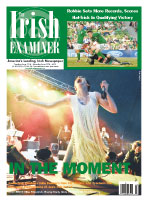
Singing Sensation Imelda May By Joe Kavanagh In the past, Ireland always had something of a knack for producing charismatic male singers who exuded a certain gravitas, imbuing them with somewhat of a spiritual component. For better or worse, names like Phil Lynott, Bono and Van Morrison all seemed to transcend their musical identities, giving them an almost iconic status among fans and peers. While this male production line has certainly continued in recent times with equally compelling singers such as Damien Dempsey and Damien Rice, it is increasingly amongst the fairer sex that the most absorbing characters in Irish music can be found in recent times. In fact, Ireland has long had a tradition of cultivating strong, independent female artists, hardly surprising given the matriarchal nature of Irish culture, which has thrown up such extraordinary female characters as the redoubtable Queen Maeve and tenacious pirate Grainne O'Malley. From legendary 19th Century opera/classical singer, Catherine Hayes, through the modern day vocalists like Sinead O'Connor, Dolores Riordan and Roisin Murphy, and uniquely talented, free-spirits such as Kate Bush and Dusty Springfield (real name Mary O'Brien) both of whom claim Irish parentage, there has always been something fiercely independent about female Irish singers. It is a trend that continues to this day, with acts of significance and substance such as Camille O'Sullivan, Wallis Bird and Lisa Hannigan all carrying this honorable tradition to a new generation. Now another name has been added to this distinct and distinguished list, with the rapid emergence of a young Dubliner that is fast proving herself to be one of the most exciting prospects in music. However, far from being some neophyte that has just stepped into the spotlight, Imelda May's entire life has been building toward this moment, and were it not for one lucky break, it may never have come. Just southwest of the city center, the area of Dublin known as The Liberties has endured more than its fair share of difficulties through the years, but through it all has maintained a tremendously strong community spirit, which is entirely befitting of one of the oldest areas of the Irish capital. It is a spirit that has supported and inspired Imelda Clabby - as she was born - throughout her life. The youngest of five children born to a painter and decorator father, whose true love was dancing, and a dressmaker, music-loving mother, she grew up in a household that brimmed with song. Encouraged by an older sister who sang and played guitar in the local church group, she was introduced to folk and traditional music at a young age, and even began harmonizing with her sister's band at only four-years-old. Although she adored singing from the outset, it was not until she turned nine-years-old, and began listening through boxes of old records that lay around her home, that she truly fell in love with music and realized that it was the only thing that she wanted to do with her life. While others in her class listened to Wham! and Nick Kershaw, she whiled away the hours under the spell of singers like Elvis, Gene Vincent and Eddie Cochrane, falling in love with not only the music of the 1950s but the entire esence of a decade that existed a generation before she was born. Encouraged by her proud parents, and the spirit of The Liberties which was quick to support one of their own, she became a dedicated student of music, inspired by the likes of Billie Holiday and Irish singers such as Mary Coughlan, Honor Heffernan and Mary Stokes. She became a fixture in Dublin pub Bruxelles (outside of which a statue of Phil Lynott now stands), where she fell in with local musicians, often performing at late-night sessions, when she was not traveling the country playing with multitudes of bands, in myriad musical styles. Through it all, she absorbed all the lessons she could, with some advice coming from the most improbable sources, such as the time she broke up with a boyfriend and left the house for a gig still visibly upset, only for her father to ask her if she was heartbroken. When she replied that she was, he simply said: "Good. You'll be able to sing the blues better." In 1998 she decided to take the next step, moving across the water to London, where she sang everywhere from pubs to burlesque shows, until she landed a place in Mike Sanchez' Blue Harlem swing troupe, who performed throughout the country in concert halls and at corporate events. Again, she took in all that she could, learning a certain level of professionalism that sometimes had her learning as many as 60-plus songs per week. She often found herself working in celebrated company, such as at private parties which were attended by the likes of the late-great Eartha Kitt and Dionne Warwick, both of whom were kind enough to impart advice. Through it all, she funded the pursuit of her dream with a series of jobs, working in launderettes, cafes and nursing homes. She also met her future husband, guitarist, Darrel Higham, whose own résumé included working with Chrissie Hynde and Screaming Lord Sutch, and the duo soon began work on what would eventually become her solo album, No Turning Back, which she released under the name Imelda Clabby, in 2003. Although it fared well with critics, a lack of funds and industry nous saw her remain in relative obscurity. Some major labels did make approaches but most offers came with unpalatable caveats, such as "lose the backing band" or "move in a more pop direction". Given her breathtaking vocal talent and the fact that she radiates the soul of another time, it was almost inevitable that she would draw comparisons to Amy Winehouse, though she recently pointed out in an interview: "I was doing my eye liner while she was still in school! I've a good ten years on her and I've really paid my dues." She also underwent something of a rebirth, emerging as Imelda May, whose look conjures the spirit of Bettie Page, Hedy Lamarr and Betty Boop, resplendent in two-tone hair style and all attendant sassiness. Despite the lack of funds, she and Higham began work on another album, as she since explained: "I thought, to hell with it, I'm going to make this album anyway, so I made it in a few days in my husband's studio - a converted cowshed. We begged and borrowed money to get the sound mix done on it. We didn't have a sound engineer, we couldn't afford to get it mastered, and even the band we had, I told them I couldn't afford to pay them, but they said, fine, pay us later. We just got on with it, and loved doing it." She continued to gig with her band, blasting out a series of covers and their own spin on rockabilly and the music of the 1950s. She even incorporated an Irish element to her music, playing a bodhrán as part of the percussion section on some of the more rambunctious numbers. She eventually came to the attention of Jools Holland, who fell in love with her act and promised her that a slot on his hugely influential BBC television show, Later With Jools Holland. Holding him to his word, her management stayed on the case but given the huge competition for spots on the program, the host had genuine difficulty getting her on his own show. In the end she got her place when Natalie Cole was forced to cancel, putting her in alongside such legends as Pink Floyd's David Gilmour and renowned guitarist Jeff Beck, who pointedly claimed that he had come on the show specifically to see May's act. She did not disappoint, putting on a performance that alternated between the blistering energy of Johnny Got A Boom Boom and the seductive beauty of Falling In Love With You Again, which showcased the sheer range and emotion of her vocal powers. Within hours of the performance, the phones started to ring as offers came in to tour with the likes of Elton John, Elbow and Diana Ross. After an intense bidding war, Universal records signed her to a multi-album deal and her album, Love Tattoo appeared last November, winning over critics with its unique style, which harkens back to another era. Its success has seen a constant diet of touring ever since as her star climbs ever further in the sky with each passing day. Only weeks ago, she picked up the Irish Meteor Award for Best Irish Female, and Virgin named her on their highly-influential list of "Ones to Watch for 2009". Anxious to retain her momentum, she has already begun work on a follow-up, although it may be some time before it sees the light of day, given the ongoing success of Love Tattoo, as evidenced by the eagerly anticipated new single, Big Bad Handsome Man, which appears in stores this week. Given her breathtaking vocal talent and the fact that she radiates the soul of another time, it was almost inevitable that she would draw comparisons to Amy Winehouse, though she recently pointed out in an interview: "I was doing my eye liner while she was still in school! I've a good ten years on her and I've really paid my dues." You also get the distinct feeling that she is more appreciative of the position she now finds herself in and has come too far to let it all slip away. The people of The Liberties must be very proud. |


CURRENT ISSUE

RECENT ISSUES

SYNDICATE
[What is this?]
POWERED BY

HOSTED BY

Terms of Service | Privacy Policy
Website Design By C3I