


SERVICES
Tuesday March 11, 2009
We're One, But We're Not The Same One
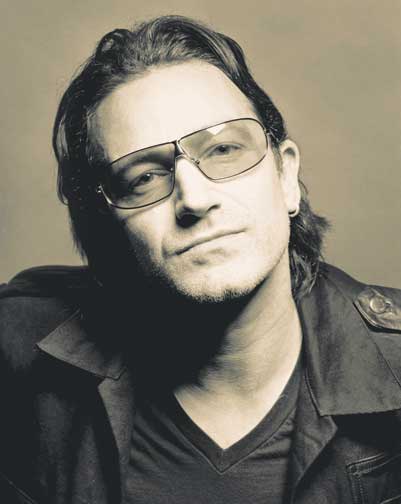
Is Bono's Mouth Writing Cheques That His Actions Can't Cash On the face of things, U2 are surfing the crest of a wave, with their critically-lauded new album sitting atop the music charts around the globe and the city of New York even temporarily naming a street in their honor last week. Their status as the biggest band in the world seems set to continue for the foreseeable future, yet under the surface of that wave lurks a shark nipping at the heels of their image as the good guys of rock. Bono and company have enjoyed a sometimes strained relationship at home, from virtually the moment that they first announced themselves as The Hype three decades ago; a relationship that increasingly appears more stressed than ever before. In a country where begrudgery is something of a national pastime, U2 have always inspired almost as much contempt as admiration among particular segments of the Irish public, and as their success grew, so too did the scorn that was poured upon it from some quarters. Until recently, much of that disdain was rightfully dismissed as the machinations of malcontents but lately a growing number of critics have begun challenging the band, and Bono in particular, for the apparent disconnect at the centre of their message. With the profligacy of banks and the death of the Celtic Tiger making economics the only issue in town, a growing number of people are expressing anger at the apparent hypocrisy of a singer that appears to be telling us all to do one thing, even as he does another. Paul Hewson, a.k.a. Bono, has always had something of the preacher about him. From his impassioned denunciation of the IRA over 20 years ago, which reputedly earned him a place on their death list, to his advocacy on a multitude of issues that have made him a globally recognized political player, he has fought for more causes than Che Guevara down through the years, albeit from behind a microphone instead of behind the barrel of a gun. His efforts on behalf of Africa, many visits to the White House and willingness to proffer opinions on everything from global debt to AIDS, have made it all but impossible to separate Bono the campaigner from Bono the musician. In 2005 he found himself particularly busy in both callings. Bono the musician spent much of the year out on the road as part of the vast Vertigo Tour, organized to promote U2's smash-hit album, How To Dismantle An Atomic Bomb. Despite the rigors of touring, he also found himself equally busy in his political life as he essentially became the face of the fight against Third World debt and knight in shining armor for Make Poverty History. He stood in front of four US presidents at the opening of Bill Clinton's library, gently encouraging their efforts in the world's most troubled continent and serenading them with sentimental songs. Visiting the G8 Summit in Gleneagles, Scotland, he implored star-struck politicians from across the globe to increase their financial aid to developing countries and cancel the crippling debts of the poorest nations on earth. He personally requested then Irish premier, Bertie Aherne, to raise Ireland's financial aid from 0.5% of the nation's Gross Domestic Product (GDP) to 0.7%, a target that was subsequently achieved. He implored Tony Blair to urge leaders to double aid to Africa to $50 billion by 2010, and badgered George W. Bush regarding economic issues to such an extent that he earned the nickname "the pest" among White House staffers. As they year drew to a close, he worked toward the launch of his latest project, RED, a brand designed to raise money for a range of global charitable causes. The range and breadth of his actions were enough to make him a contender for the Nobel Peace Prize and a co-winner of Time Magazine's Person of the Year, an honor he shared with Bill and Belinda Gates. Bono had reached his unquestioned apotheosis as a campaigner par excellence, almost saintly in his appeal and intent. Then, in the minds of some, the wheels fell off hid bandwagon, sparked by the decision of the Irish government to put a cap on tax-free earnings for artists from royalties at €250,000 ($317,000). The previously lenient taxation system on artists meant that U2 paid only $46,500 on such earnings in in 2005, a figure that rose to $1.1 million under the new system. Speaking about such a scenario to the Belfast Telegraph in 2005, Bono claimed: "Our publishing, which is about one third of our income, we have tax breaks on, and that's great and that's encouraged us to stay in Ireland and if that changes, it's not going to affect anything for U2..." Except it did. "Behind Bono's working-class, man-of-the people facade lies someone whose love of money is matched only by his obsession with making even more of it." It appeared inconsistent with Bono's preachings at the very least, and downright duplicitous to those more inclined to poke at the singer's halo. Ironically, given the fact that it was Mayor Bloomberg who hosted the street-naming ceremony last week, it was Bloomberg News journalist, Fergal O'Brien, who was among the first to point out the seeming hypocrisy of Bono's ways, writing: "Bono, the rock star and campaigner against Third World debt, is asking the Irish government to contribute more to Africa. At the same time, he's reducing tax payments that could help fund that aid." Some were even more direct, with Paul Scott, in an article entitled, St. Bono The Hypocrite, writing: "Behind Bono's working-class, man-of-the people facade lies someone whose love of money is matched only by his obsession with making even more of it." Time and the collapse of the global economy have only served to sharpen such criticism, with some openly postulating that Bono's advocacy is somewhat self-serving, such as Expensive Habits: The Dark Side of the Music Industry author, Simon Garfield who was quoted as saying: "Bono's campaigns reflect a great amount of concerns that U2's audience also has, such as AIDS and malaria in Africa, and that can't help but have a beneficial effect on record sales." Others point to the fact that the Red brand allegedly spent $101.4 million on marketing in 2007, while raising only $18 million for AIDS and HIV treatment. Speaking in defense of the figures, company CEO, Bobby Shriver claimed that the money donated was five times the amount given to the Global Fund by the private sector in four years, a hollow comment that surely speaks more to the stinginess of the private sector than the effectiveness of RED. This criticism reached a peak on Wednesday, February 25th when a group called Debt and Development Coalition Ireland (DDCI), staged a protest to mark the launch of U2's latest album. Nor was this some ragtag collection from the lunatic fringe, but an umbrella group for over 70 organizations, including Concern, Trocaire, Oxfam and a host of other global charities. Condemning U2's tax evasion, DDCI spokesperson, Nessa Ni Chassaide, proclaimed: "We wanted to raise our concern that while Bono has championed the cause of fighting poverty and injustice in the impoverished world, the fact is that his band has moved part of its business to a tax shelter. Tax avoidance and tax evasion costs the impoverished world at least $160m every year. This is money urgently required to bring people out of poverty." Bono has admitted in the past that his band mates have expressed concern that his antics would someday affect their music career and it seems that those fears have now become realized. In their defense, guitarist Edge claimed last week: "Our business is a very complex business. Of course we're trying to be tax-efficient. Who doesn't want to be tax-efficient?" Journalist Nick Cohen of The Guardian, perhaps put it best when he maintained that such a comment made the guitarist sound "as edgy as a plump accountant in the 19th hole." Manager Paul McGuinness claimed it was much ado about nothing because the band does 95% of its business outside of Ireland in any case, but if such a statement was true, then why bother upping sticks to the Netherlands at all? Others are quick to point out the irony that if Bono simply behaved like other rock stars, going through life without a care for anything outside his bank balance then he would not be coming under such criticism; an example of circular logic if ever there was one. The fact is that whether driven by ego or altruism Bono is the one who assumed the mantle of champion of the poor, becoming a wealthy man in the process and for many, the matter boils down to a case of ante up or shut up. The African Union has stated that an estimated $150 billion is lost to that continent every year through tax evasion schemes, which represents three times the amount of aid that Africa receives. Bono's words may put him in the camp of the indigent but his actions make him a poster boy for the side he preaches against, and we all know the adage regarding which speaks louder. |

CURRENT ISSUE

RECENT ISSUES


SYNDICATE
[What is this?]
POWERED BY

HOSTED BY

Terms of Service | Privacy Policy
Website Design By C3I